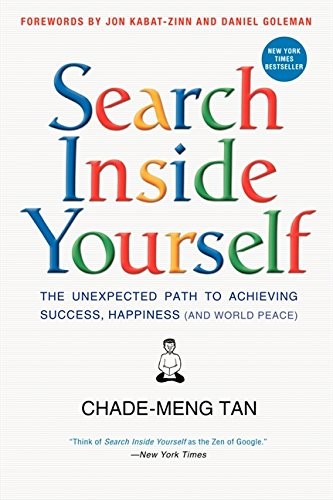
Search Inside Yourself by Chade-Meng Tan
With forewords by Daniel Goleman and Jon Kabat-Zinn
Emotional intelligence enables three things: stellar work performance, outstanding leadership, and the conditions for happiness.
EI is the ability to monitor one’s own and others’ feelings, discriminate among them, and use that information to guide thinking and action.
On attention
Mindfulness trains attention that is strong in both clarity and stability.
Jon Kabat-Zinn’s definition: paying attention in a particular way — on purpose, in the present moment, non-judgmentally.
Scientific definition (Julie Brefczynski-Lewis): “a family of mental training practices designed to familiarize the practitioner with specific types of mental processes.”
When the mind is highly relaxed and alert simultaneously, three qualities emerge naturally: calmness, clarity, happiness.
On meditation as a skill, not a ritual
Maintain mindfulness over three things: intention, movement, sensation.
Full moment-to-moment attention to every task with a non-judgmental mind. Every time attention wanders, gently bring it back. The task is the object of meditation, not the breath.
Mindfulness is the faculty of voluntarily bringing back a wandering attention — over and over again.
The Expensive Food Meditation: pretend every meal is rare and expensive. Give it full attention.
On conversation
Three components of mindful conversation:
- Listening — giving the gift of attention to the speaker
- Looping — closing the loop by demonstrating you heard what was actually said
- Dipping — checking in with yourself, knowing how you feel about what you’re hearing
On the nature of thoughts and emotions
Thoughts and emotions are like clouds — some beautiful, some dark. Our core being is the sky. Clouds are not the sky.
Thoughts and emotions are not who we are. They are phenomena in mind and body that come and go.
Self-regulation is not about avoiding, denying, or repressing emotions.
Five emotional competencies under self-regulation:
- Self-control
- Trustworthiness
- Conscientiousness
- Adaptability
- Innovation
In an enlightened mind, unwholesome thoughts are like writing on water — written and gone.
On suffering and pain
Pain and suffering are qualitatively distinct. One does not necessarily follow the other.
The key is letting go of two things: grasping and aversion.
- Grasping: the mind desperately holds on and refuses to let go
- Aversion: the mind desperately keeps something away and refuses to let it come
Aversion, not pain itself, is the actual cause of suffering. The pain is just a sensation that creates the aversion.
“If you are distressed by anything external, the pain is not due to the thing itself, but to your estimate of it; and this you have the power to revoke at any moment.” — Marcus Aurelius
The biggest problem with pleasant experiences: they all eventually cease. The experience causes no suffering. Our clinging and desperate hope that they won’t end — that causes suffering.
When you are not in pain, be aware that you are not in pain.
On befriending emotions
Do not feel bad about feeling bad.
Try to experience emotional difficulty as a physiological phenomenon, not an existential one.
Rumi’s Guest House: welcome every arrival — joy, depression, meanness. Even the crowd of sorrows violently sweeping the house empty may be clearing you out for a new delight.
On work and motivation
The most logical path toward sustainable happiness at work: most time on higher purpose, sometimes in flow, occasionally savoring pleasure.
The best way to find motivation at work: find your own higher purpose.