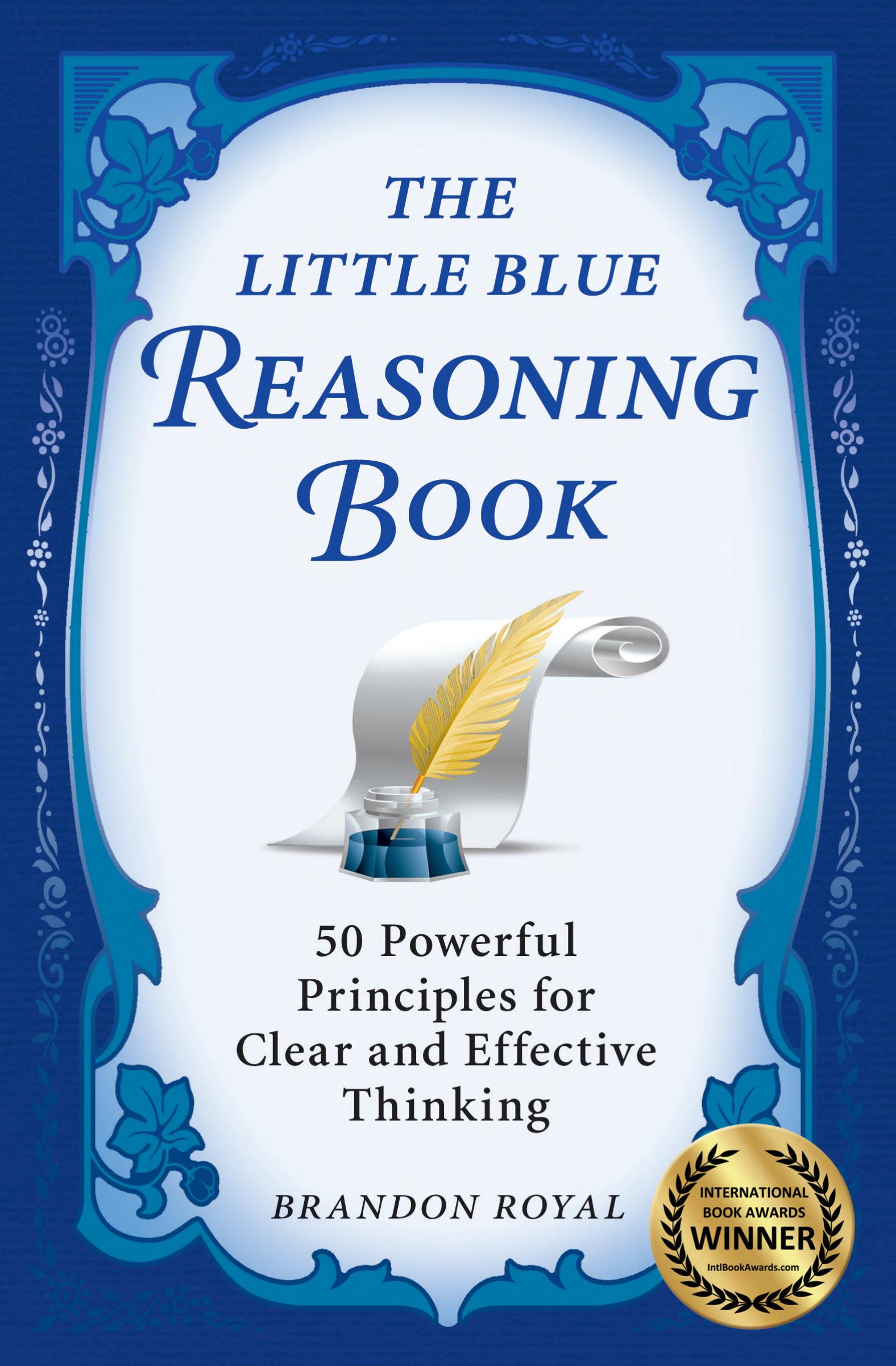
The Little Blue Reasoning Book: 50 Powerful Principles for Clear and Effective Thinking by Brandon Royal
On perception and mindset
Selective perception is the tendency to see the world the way we would like it to be rather than how it really is. The sound thinker suspends judgment and is not unduly influenced by stereotypes, prejudices, isolated experiences, or preconceived notions.
On creative thinking
Creative thinking is “backdoor” thinking.
Convergent thinking focuses the mind; divergent thinking opens the mind.
The devil’s advocate technique imposes objectivity and compels divergent thinking.
The three greatest creativity inhibitors: not challenging the obvious, evaluating ideas too quickly, and fear of looking the fool.
Consider whether a problem is really the problem. Think in terms of redefining the problem.
On arguments
Evidence + Assumption = Conclusion. The assumption is the glue that holds the evidence to the conclusion.
There are effectively two ways to attack an argument: attack the evidence or attack the assumption(s).
Four types of logical statements to recognise:
- “If … then” statements
- “No-some-most-all” statements
- Mutual inclusivity and exclusivity
- Logical equivalency statements
The five common reasoning errors
- Comparing apples with oranges
- Overgeneralizing on the basis of small samples
- Ignoring relevant evidence
- Confusing cause and effect
- Failing to anticipate bottlenecks when plans are put into action
On causation and correlation
Correlation does not equal causation.
Test the opposite scenario — if you hear that a full moon causes the crime rate to rise, always ask what the crime rate is like when the moon is not full.
On plans and action
Theory may be divorced from practice. Plans may not equal completed action. Do not assume that plans will be implemented without a hitch.
One way to uncover implementation assumptions is to anticipate bottlenecks.
On persuasion
Most people are moved more by the depth of a person’s conviction and commitment than they are by the details.
On sunk costs
Sunk costs are irrelevant to future decision making.
On recognition
Searching for something does not guarantee that we’ll recognise it once we’ve found it. The ability to accurately identify what we are seeking to find may itself be a key assumption.