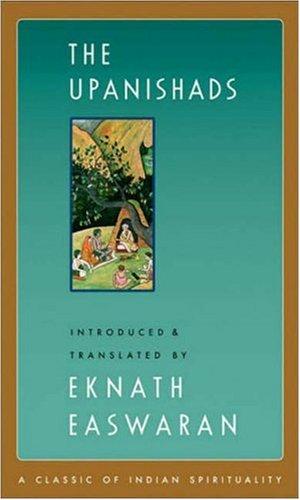
The Upanishads translated by Eknath Easwaran (2nd Edition)
We spend our days in the familiar world of our five senses, but what lies beyond that — if anything — we have no idea.
The real drive of these ancient texts is not so much to know the unknown as to know the knower.
Three texts, three formats
The Upanishads, the Bhagavad Gita, and the Dhammapada are among the earliest and most universal messages sent to inform us that there is more to life than the everyday experience of our senses.
- The Upanishads are like slides — snapshots of towering peaks of consciousness taken at various times by different observers, dispatched with just the barest explanation.
- The Dhammapada is more like a field guide — sayings of the Buddha gathered around symbols and metaphors, easy to commit to memory.
- The Bhagavad Gita is a map and guidebook — a systematic overview of the territory, showing various approaches to the summit with their benefits and pitfalls. It tells us what to pack and what to leave behind.
On consciousness
They describe the topography of consciousness itself.
This wider field of consciousness is our native land. We are not cabin-dwellers, born to a life cramped and confined; we are meant to explore, to seek, to push the limits of our potential as human beings. The world of the senses is just a base camp: we are meant to be as much at home in consciousness as in the world of physical reality.
“What is that one by knowing which we can know the nature of everything else?” They found the answer in consciousness. Its study was called brahmavidya.
Brahmavidya is not psychology or philosophy. It is, in a sense, a lab science: the mind is both object and laboratory. Attention is trained inward, on itself, through a discipline the Upanishads call nididhyasana: meditation.
Meditation here is not reflection or any other kind of discursive thinking. It is pure concentration — training the mind to dwell on an interior focus without wandering, until it becomes absorbed in the object of its contemplation.
On training the mind
The faculty of voluntarily bringing back a wandering attention over and over again is the very root of judgment, character, and will. An education that should include this faculty would be the education par excellence.
Their ideal was not to retire from the world but to live in it selflessly, with senses and passions completely under control.
On joy
There is no joy in the finite; there is joy only in the Infinite.
On the Vedic spirit
These hymns, dating from perhaps 1500 B.C., reveal an intimate, almost mystical bond between worshipper and environment — a simultaneous sense of awe and kinship with the spirit that dwells in all things.
A burning desire to know, to find central principles which make sense of the world we live in. For singleness of purpose and strength of will.
With each reading I feel I am setting out on a sea so deep and vast that one can never reach its end.