Vibecoding 014 — A P.G. Wodehouse Quote Bot for Bluesky
Table of Contents
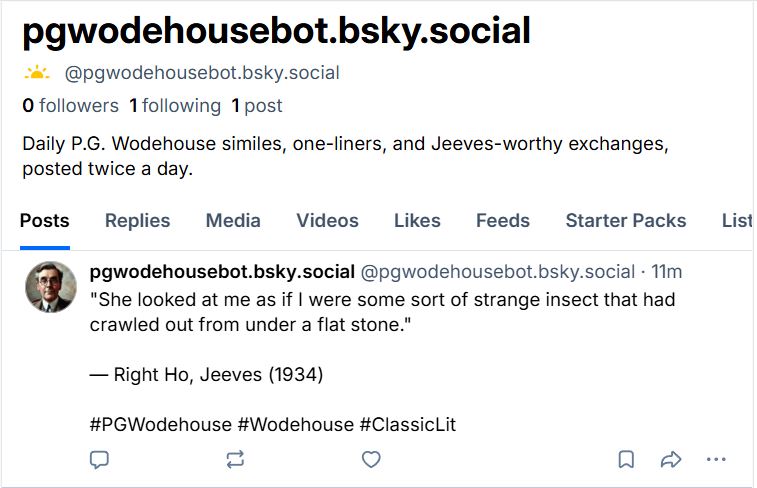
P.G. Wodehouse wrote 97 books. He was also, sentence for sentence, one of the funniest writers in the English language. Most people know Jeeves and Bertie Wooster. Fewer know the Blandings Castle stories, the Mulliner tales, or the sheer density of comic simile he packed into every paragraph.
I wanted a bot that would surface this — not by dumping quotes randomly, but with structure. A different format each day of the week. The similes on Monday (they are the most shareable, and they earn a second slot on Saturday). Dialogue exchanges on Wednesday, posted as a thread. Character spotlights on Thursday. A wildcard on Sunday for whatever didn’t fit anywhere else.
The result posts to @pgwodehousebot.bsky.social twice a day, runs entirely on GitHub Actions, and costs nothing to operate.
→ github.com/mr-dinesh/wodehouse-bot
The Format Rotation #
A bot that just posts quotes gets boring quickly. What made Wodehouse worth returning to is variety — the way a simile lands differently from a dialogue exchange, which lands differently from a narrator’s aside. So the week has a structure:
| Day | Format | What it is |
|---|---|---|
| Monday | Simile | The pure comparison — Wodehouse’s signature move |
| Tuesday | Setup + Quote | One line of context, then the killer one-liner |
| Wednesday | Dialogue | A two-post thread — the exchange, then the comeback |
| Thursday | Character Spotlight | Who said it, with context about the speaker |
| Friday | Situation | Scene-setting followed by the payoff |
| Saturday | Simile | Another one — they earn a second slot |
| Sunday | Wildcard | Anything that didn’t fit elsewhere |
Wednesday’s dialogue format is the most technically interesting. Bluesky threads work through reply references — you post the first toot, take its uri and cid, and pass those as the reply anchor for the second. The exchange between two characters maps naturally to this: the opening line first, the comeback in reply.
The Code #
Four files:
bot.py         # entry point — loads quotes, picks one, posts it
scheduler.py   # maps day-of-week → format type
templates.py   # one render function per format
poster.py      # Bluesky client (atproto)
bot.py is deliberately thin. It parses arguments, loads data/quotes.json, picks a quote matching today’s format, and calls publish(). The format logic lives entirely in templates.py; adding a new format means adding one function and one entry in the scheduler’s day-map. The quotes are plain JSON, easy to extend by hand.
The Bluesky posting client uses the atproto SDK:
def post_bluesky(text: str, reply_ref=None) -> dict:
    client = BskyClient()
    client.login(os.environ["BSKY_HANDLE"], os.environ["BSKY_APP_PASSWORD"])
    kwargs = {"text": text}
    if reply_ref:
        kwargs["reply_to"] = reply_ref
    return client.send_post(**kwargs)
Credentials come from environment variables only — BSKY_HANDLE and BSKY_APP_PASSWORD. No config files, no hardcoded values. The app password is scoped to posting only; revoke it without touching the account if it ever leaks.
Zero-Server Scheduling #
GitHub Actions fires the script twice a day:
on:
  schedule:
    - cron: '0 7 * * *'    # 07:00 UTC morning
    - cron: '0 17 * * *'   # 17:00 UTC evening
  workflow_dispatch:         # manual trigger for testing
No VPS, no always-on process, no bill at the end of the month. The runner spins up, posts, and exits. The only persistent state is the quotes JSON file in the repo.
workflow_dispatch lets you trigger a post manually from the GitHub Actions tab — useful for testing after a credential rotation or a quotes update without waiting for the next scheduled run.
Bluesky Only #
The bot started with both Mastodon and Bluesky wired up. Removing Mastodon was a clean three-file change: drop the post_mastodon() function and its import from poster.py, remove Mastodon.py from requirements.txt, and drop the two Mastodon secrets from the workflow env block. The publish() function went from twelve lines to five.
The Mastodon account will come back when a separate instance account is set up for the bot. For now, Bluesky only.
What Vibecoding This Felt Like #
The build was fast — a single session. The interesting decisions were about structure, not code.
The format rotation idea came early: a bot that posts similes every day is a one-joke bot. One that posts seven different things, each matched to a day, is something you might actually follow. The scheduler.py file is four lines of a dictionary. It took longer to decide the mapping than to write it.
The quotes JSON schema went through one revision. The first pass had too many required fields. The cleaner version has four required (id, format, text, book) and the rest nullable — setup, dialogue_response, character, year. A null field is just not rendered. This means adding a new simile quote is a four-field entry; adding a dialogue is ten fields. The schema earns its complexity only where it needs to.
Claude Code handled the atproto thread reply reference without prompting — it knew the AT Protocol reply format from context. That was the kind of thing that used to require a documentation detour.
@pgwodehousebot.bsky.social
Part of the 100 Vibe Coding Projects series.