Vibecoding 018 — Rescuing 247 Notepad++ Quotes Before They Stay Hidden
Table of Contents
The itch #
Notepad++ has a hidden easter egg most people never find. Type the word random anywhere in the editor, select it, and press F1. A small window pops up with a single quote — a random one, drawn from a list of 247 buried in the source code. Sometimes it’s a programming aphorism. Sometimes it’s dark humour. Sometimes it’s completely unhinged.
“Always code as if the guy who ends up maintaining your code will be a violent psychopath who knows where you live.” — Martin Golding
I stumbled on this years ago and kept triggering it when I wanted a laugh. Then one day I actually wanted to find a specific quote I’d seen, and realised I had no way to. The window appears, shows one quote, and closes. There’s no index. No searchable list. The only way to find any given quote is to keep hitting the easter egg and hope.
That felt like a solvable problem.
The idea #
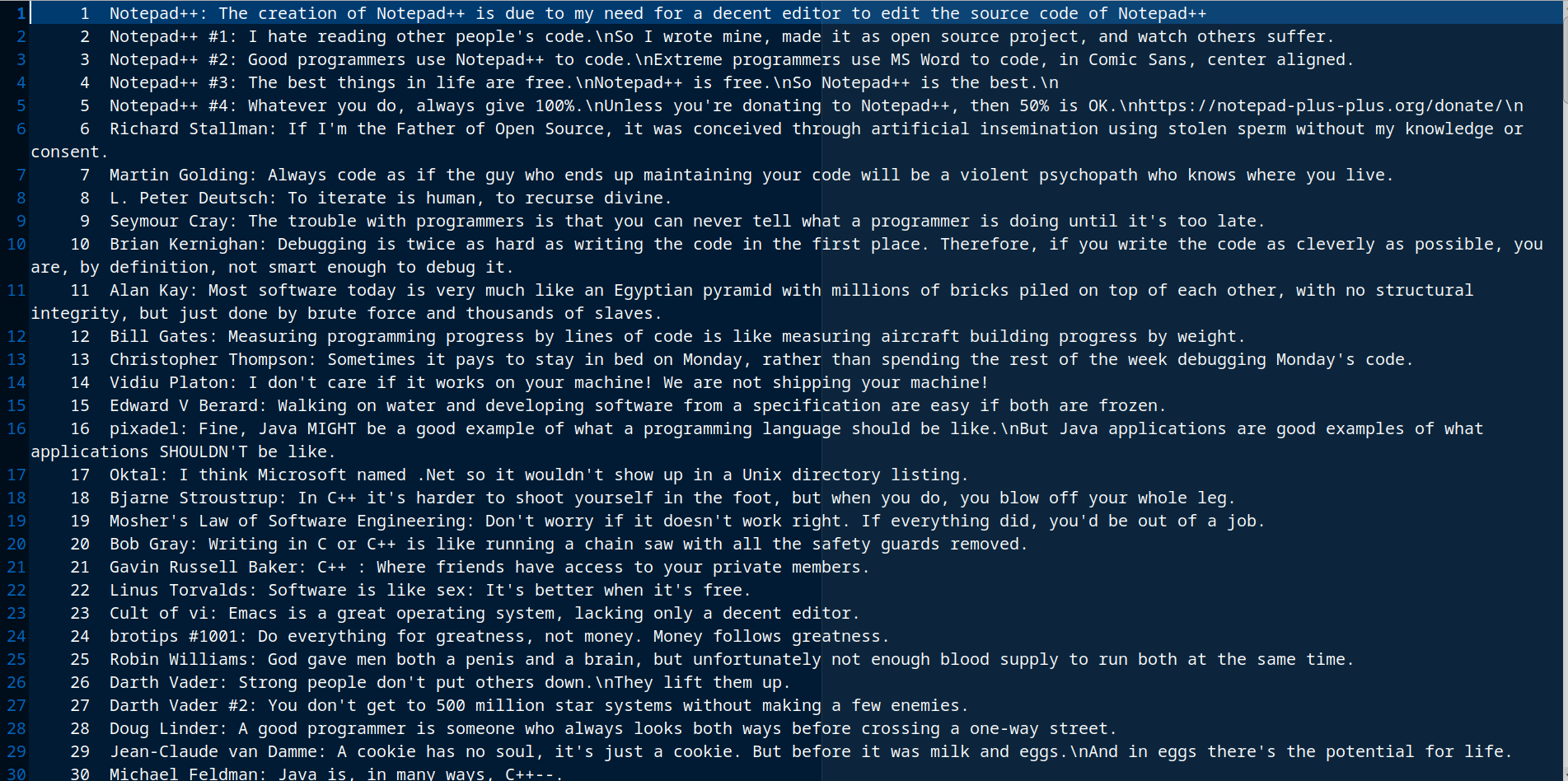
The Notepad++ source code is public. The quotes live in a single file: a long list of attribution + text pairs, with \n as literal line breaks inside each entry. The format is consistent enough that a parser could extract every quote cleanly.
The goal: pull all of them out, clean up the escape sequences, and have a proper flat file I could actually use.
The build #
The raw file had 274 lines. Each line follows this pattern:
Author: Quote text with \n for line breaks
Some entries have numbered variants (e.g. Don Ho #3:, Anonymous #42:). Some have URLs embedded. Some span what would be multiple paragraphs if the \n sequences were rendered.
The parser does two things:
- Splits on the first
:to separate attribution from text - Replaces
\nliterals with actual newlines
What came out was 247 distinct quotes, spanning:
- Programming legends — Kernighan, Stroustrup, Ritchie, Torvalds, Knuth territory
- Don Ho originals — the Notepad++ author contributed several of his own, ranging from philosophical to deliberately absurd
- Anonymous community submissions — the bulk of the list; these are the ones that made the rounds on forums circa 2006–2015
- Wildcard entries — a Space Invaders ASCII art render, a Dennis Ritchie quote rewritten as a Bruce Lee parody, and
Internet #404: Quote not Found
A few favourites that hold up:
“Debugging is twice as hard as writing the code in the first place. Therefore, if you write the code as cleverly as possible, you are, by definition, not smart enough to debug it.” — Brian Kernighan
“The plural of regex is regrets.” — Anonymous #202
“int getRandomNumber() { return 4; // chosen by fair dice roll, guaranteed to be random. }” — xkcd.com
“Why do programmers always mix up Halloween and Christmas? Because Oct 31 == Dec 25” — Anonymous #195
“Artificial Intelligence is no match for natural stupidity.” — Terry Pratchett
Word of the Day: DEBUGGING — The classic mystery game where you are the detective, the victim and the murderer.
The output is two files: npp_quotes_raw.txt (one quote per line, attribution inline, \n literals preserved) and npp_quotes.txt (same list, \n sequences rendered as actual newlines, ready to read or pipe).
What you can do with 247 quotes #
The extraction is the easy part. What makes it worthwhile is everything downstream.
1. Terminal MOTD #
Drop this in your .bashrc or .zshrc:
shuf -n 1 ~/npp_quotes.txt
Every new terminal session greets you with a random quote. Takes ten seconds to set up.
2. Mastodon / social bot #
The kagga_bot skeleton in this same repo was built for exactly this kind of data. Swap in the quotes file, set a posting schedule, and you have a daily Notepad++ quote bot. The quotes are short enough to fit comfortably within character limits, and varied enough that you could post one a day for eight months without repeating.
3. Static JSON API #
Convert the flat file to a JSON array once:
import json, pathlib

lines = pathlib.Path("npp_quotes.txt").read_text().splitlines()
quotes = []
for line in lines:
    if ": " in line:
        author, text = line.split(": ", 1)
        quotes.append({"author": author.strip(), "quote": text.strip()})

pathlib.Path("quotes.json").write_text(json.dumps(quotes, indent=2, ensure_ascii=False))
Host quotes.json on any static file server. Any page can fetch a random one with a single fetch() call and no backend.
4. Hugo shortcode for this blog #
A random-quote shortcode that reads from the JSON at build time — or a small JS snippet that fetches it client-side — would let any Vibecoding post pull in a contextually relevant quote without me having to look one up manually.
5. Screensaver / wallpaper generator #
Feed the quotes into something like quote-wallpaper or a simple Pillow script. Rotating desktop wallpaper with a new quote each morning. The ones with ASCII art (Space Invaders, the xkcd snippet) render surprisingly well in monospace.
6. Random quote widget #
All 247 quotes are embedded below. A random one loads each time — hit the button to cycle through them.
Loading...
What vibecoding this felt like #
This one was tiny by project standards — maybe two hours from “I wonder if these are extractable” to clean output file. No server, no API, no framework. Just a text file, a small parser, and a satisfying flat list at the end.
But there’s something worth noting about small extractions like this. The quotes don’t live anywhere useful in their original form. They’re buried in C++ source, rendered once in a dialog box, and effectively inaccessible. Extracting them doesn’t create anything new; it makes something already real findable. A lot of useful work is exactly this shape: rescuing something that already exists but can’t be reached.
The kagga_bot project earlier in this series did the same thing for Kannada poetry. Same instinct. Make the thing findable. Give it a URL or a flat file or a JSON key. The value was always there — you just had to open a door.
github.com/mr-dinesh/npp-quotes
Part of the 100 Vibe Coding Projects series.